strategy
how often should a local business actually post?
ask five marketers how often you should post and you'll get five answers. post daily. post three times a week. post whenever you have something good. most of that advice is written for brands in general, not for a taqueria with 40 seats or a roofing crew that's on a job site all day.
running social for local businesses is the whole job here, so this is the answer i'd give a client who asked. i pulled the raw numbers from Hootsuite, Sprout Social and Buffer, then filtered them through what actually holds up for a local business instead of a national brand. the published ranges are a fine starting point. knowing which end fits a taqueria and which fits a roofer is the actual job.
short version: there's a range that works for almost everyone, and where you land inside it depends mostly on one thing. how often your customer buys.
what we actually recommend
here's where i'd start you, platform by platform.
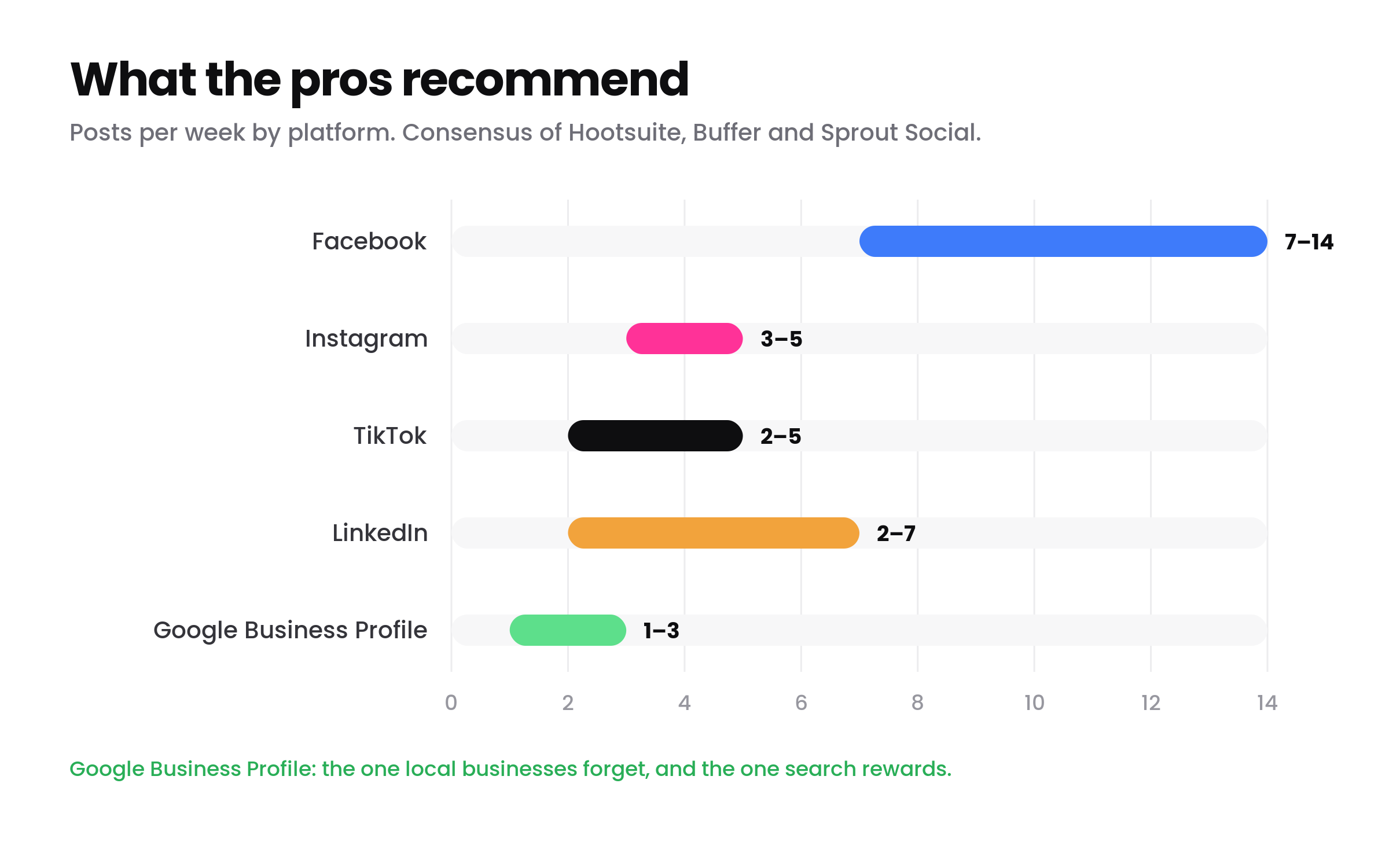
- instagram: 3 to 5 feed posts a week. hootsuite and buffer land on the same range independently.
- facebook: 1 to 2 posts a day is the standard advice. the feed moves fast and organic reach is thin, so frequency matters more here.
- tiktok: 2 to 5 a week. tiktok itself says 1 to 4 a day, but real brands average about two videos a week and do fine.
- linkedin: 2 to 7 a week, and only if your customers are actually there.
- google business profile: at least once a week. standard gbp posts stop showing prominently after about seven days, so weekly is the floor that keeps your listing looking alive.
two things jump out. first, the recommendations cluster tight. instagram lands at 3 to 5 a week across almost every credible source. second, the averages are falling. sprout's data shows brands averaging 9.5 posts per day across all their networks combined, down from 11 in 2022. big brands are pulling volume back on purpose.
more posting stopped being the answer
this is the part most local businesses get wrong in both directions. some post twice a year. some burn out trying to post daily because a guru said so. the data says neither works.
hootsuite's engagement research found that two good posts a week will get you more total engagement than 20 pieces of mediocre content, and that 6 to 7 great posts a week is the sweet spot on instagram. their own social team puts it plainly: three quality posts are worth more than five low-quality ones.
buffer looked at over 100,000 accounts and found that regular posting drives about 5x more engagement than posting in bursts. not more volume. more regularity. the account that posts three times a week, every week, beats the one that posts ten times and disappears for a month.
and buffer's instagram reach data shows why chasing volume has a ceiling. moving from 1 to 2 posts a week up to 3 to 5 lifts reach per post by about 12%. pushing all the way past 10 a week only gets you to about 24%. the returns shrink with every jump. the workload doesn't.
so the real question was never "what's the maximum i can post." it's "what's the most i can post well, every single week, without falling off." and that number is different for a restaurant than it is for a roofer.
the variable that changes everything: how often your customer buys
someone decides where to eat a few times a day. every single post from a restaurant has a shot at catching someone mid-decision. tonight's special, posted at 4pm, puts people in seats at 7.
now the roof. a homeowner replaces a roof about once every 15 to 25 years. no amount of posting makes someone need a roof sooner. posting daily doesn't create demand, it just talks to people who aren't in the market yet.
that doesn't mean the roofer should skip social. it means the roofer's social has a different job. the restaurant posts to trigger a purchase. the roofer posts to be the obvious, trusted choice on the day a storm hits or a leak shows up. proof of work, reviews, before-and-afters, a google business profile that looks alive. when the buying moment finally comes, the homeowner searches, and the roofer with 60 job photos and fresh reviews wins over the one whose last post was 2023.
high purchase frequency, high cadence. low purchase frequency, lower cadence but heavier proof.
one more factor stacks on top: how visual the work is. food, hair and a freshly cleaned kitchen photograph well and get shared. attic insulation doesn't. the more naturally visual your work, the more the higher end of the range pays off.
the industry data backs this up. hootsuite's q1 2025 numbers show dining and hospitality brands posting 11.9 times a week on instagram, while construction brands post 7.3. the market already behaves this way. the businesses just don't always know why.
suggested cadences by business type
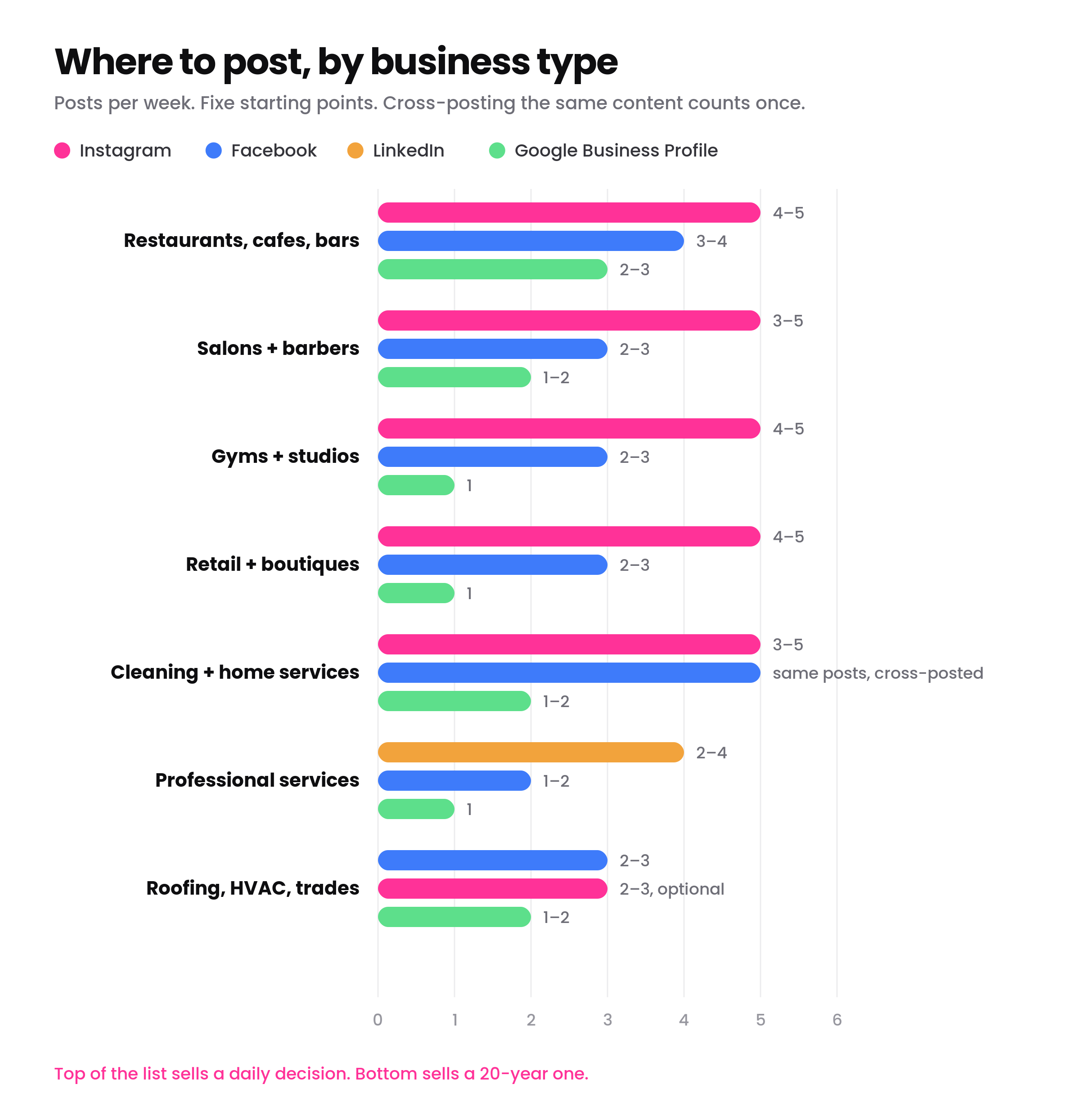
these are starting points, not laws. every number assumes you can hold it every week. if you can't, drop a tier. a held schedule at three posts beats a broken one at six.
restaurants, cafes, bars
the highest cadence on this list, because you sell a daily decision. instagram: 4 to 5 feed posts a week, stories most days, 1 to 2 reels a week. facebook: 3 to 4 a week, cross-posted is fine. google business profile: 2 to 3 a week, tied to specials and events. food is the most shareable content a local business can make. use it.
salons, barbers, med spas
instagram: 3 to 5 a week plus stories. before-and-afters are the whole game. facebook: 2 to 3. gbp: 1 to 2. rebooking cycles run 3 to 8 weeks, so your feed doubles as a rebooking reminder.
cleaning and recurring home services
instagram and facebook: 3 to 5 a week, same posts cross-posted to both. transformation content, the gross-to-gorgeous reveal, performs far above its weight here. gbp: 1 to 2. you're selling a repeat service, so cadence keeps you top of mind between visits and in front of the neighbors.
roofers, hvac, plumbers, electricians
facebook: 2 to 3 a week, because that's where local homeowners are. instagram: 2 to 3 if the work photographs well, and cross-posting covers most of it. gbp: 1 to 2, non-negotiable, because these customers come through search. keep the mix heavy on completed jobs, reviews and process. skip tiktok unless you actually enjoy making video, and never let it eat your gbp and review effort.
gyms, studios, fitness
instagram: 4 to 5 a week plus stories. member results and community are the engine. facebook: 2 to 3. gbp: 1. motivation content has a short shelf life, so frequency matters more than polish here.
professional services (law, accounting, real estate)
linkedin: 2 to 4 a week. this is the one category where linkedin beats instagram. facebook: 1 to 2. gbp: 1. educational content builds the trust these purchases require. volume matters less than being visibly credible.
retail and boutiques
instagram: 4 to 5 a week plus stories for drops and restocks. facebook: 2 to 3. gbp: 1. pinterest is worth a test here, it's one of the few categories where it moves local product.
if you can only manage the minimum
real talk for the owner doing this at 9pm: here is the floor. three posts a week on your main platform. one post a week on google business profile. stories whenever something is actually happening. that's it.
that floor keeps your profiles alive and keeps you in the algorithm's rotation. buffer's small business guidance lands in the same place: 2 to 5 posts a week on your key channels, held steadily. below the floor, profiles start to look abandoned, and an abandoned profile actively costs you customers. people check your instagram and your google listing before they call. a last post from eight months ago reads as "might be out of business."
the rules that matter more than the number
- hold the schedule. consistency compounds. buffer's 100,000-account study found regular posting drives about 5x more engagement than erratic posting at higher volume.
- quality sets the ceiling. sprout's index research found people decide to follow based on originality and how you interact with them, not how often you post.
- reply fast, especially in the first hour. early engagement is a signal every platform rewards. posting and vanishing wastes the post.
- batch it. nobody holds a schedule making posts one at a time. shoot once, post for two weeks. this is the single biggest workload unlock for a busy owner.
- track one thing. not eight metrics. pick one, like profile visits, dms or direction requests on gbp, and watch whether it moves over a month.
where this leaves you
the right cadence comes down to two questions. how often does your customer buy, and how visual is your work? answer those, pick your tier, then hold it for 90 days before you judge it.
and if holding it is the problem, that's the exact thing we do. fixe runs organic social for local businesses on a flat monthly rate: the calendar, the posts, the captions, the scheduling. you run the business, we run the feed. see the packages or tell us about your business and we'll tell you honestly what cadence you actually need.
sources